According to the globally influential, US-based National Institute of Drug Abuse (NIDA), these neurobiological changes are proof of brain illness. Lewis disagrees. Such changes, he argues, are induced by any goal-orientated activity that ends up being all-consuming, such as gambling, sex addiction, web gaming, discovering a brand-new language or instrument, and by strongly valenced activities such as falling in love or religious conversion.
"It even applies to making cash," Lewis states of this deep learning. "There have actually been research studies revealing that individuals making high-powered choices in company and politics also have really high levels of dopamine metabolic process in the striatum, since they remain in a constant state of goal pursuit." The result of continuously promoting this reward system keeps the user focused only on the minute.
"You have actually lost the concept of yourself being on a line that extends from the past into the future. You're just drawn into this vortex that is the now." While the illness concept recommends that a person who has actually ended up being abstinent will be in treacherous remission forever, Lewis argues that brand-new habits can overwrite old.
"Goals about their relationships and feeling entire, connected and under control. The striatum is extremely activated and trying to find those other objectives to link with. "There was a study made on addicts of drug, alcohol and heroin, and it revealed that six months to a year into their abstinence there were regions of the prefrontal cortex that had formerly showed a decrease in synaptic density from underuse, which had gone back to baseline and then gone beyond standard.
What's indisputable is that the disease principle they decline is deeply ingrained into our culture, mainly through Alcoholics Anonymous. There can be few American TV serials that haven't illustrated a recovering alcoholic leaving their location in the circle of chairs, to try to control their own drinking. When the doomed character dramatically relapses in a bar, the message strengthens the "Minnesota Design" of disease, adopted by AA in the 1950s: that alcohol addiction is an involuntary impairment, not the sign of an underlying issue.
Even as a member vigilantly goes to meetings in church halls, their illness is, it's said, "doing push-ups in the parking lot". In other words, attempt to stop going to meetings and it'll king-hit you. Lewis doesn't completely discredit AA which in Australia has close to 20,000 members however he does suggest that while 12-step healing "works for some addicts, it does so by promoting a kind of PTSD".
"It's actually a scams," he says, "when there are better ways, such as outpatient rehabilitation. With that, you're not being blended off to some pastoral environment, investing a month getting clean, and after that being sent back to the environment where you became addicted, which is a set-up for relapse and additional costs." Teacher Steve Allsop, from Curtin University, is worried that the illness design over-simplifies alcohol and drug problems with one-size-fits-all evaluation and treatment.
Some Ideas on How To Combat Drug Addiction You Should Know
This design advocates harm-reduction, with abstaining at one end of the spectrum. "That's not the exact same as anarchy," he laughs, "I'm not suggesting anything goes. But some individuals discover in-patient care important, or long-term aid in a college community such as AA, or are helped by particular pharmacotherapies. No single technique has been demonstrated to be 'the method'." As the US hasn't had the totally free or subsidised health system that the United Kingdom and Australia delights in, a person requires to have a definable illness in order to have treatment covered by medical insurance, so to have NIDA classify dependency as a persistent brain illness facilitates that process.
Carl Hart has actually complained that, as one opposed to the illness design, he doesn't receive moneying any more. As Lewis says: "You do not bite the hand that feeds you." Teacher Suzanne Fraser is the leader of Australia's NDRI's Social Researches of Dependency Concepts Research study Program and one of the authors of the book Practices: Remaking Dependency.
"It appears Volkow's technique to dependency is in part informed by her own experiences of household drug usage in [The] Huffington Post she's called her grandpa's alcohol problem a 'illness of free choice'. Like other researchers her view is formed by her individual experiences, yet NIDA's research exists as though it has actually attained a bias-free perspective, from which it can inform us the fact of drugs and dependency." Professor Alison Ritter, director of the Drug Policy Modelling Program at the University of NSW says that when the illness model was first adopted by NIDA it was to both de-stigmatise dependency and, by making it a medical condition, it would be eligible for federal government financing for treatment and research.
"There seemed to be a shift from the term 'disease' as a rhetorical gadget to something that Americans believed literally. This streamlines reliance to brain chemistry. In truth it is a complicated cultural, social, psychological and biological phenomenon." Ritter forecasts tiredness with the brain disease design. "It has not produced any brand-new technologies for treatment nor always decreased stigma or enhanced the great deal of people who experience dependence issues," she states.
"I concur with his [Hari's] focus on the importance of connection," states Lewis. "He states 'the war on drugs' is precisely the incorrect term and I concur with that, too." Not all of Lewis' conferences are likely to be so unified he's guaranteed to lose friends and push away individuals at every conference he attends, though he's particularly claiming a pas de deux with the NIDA's Nora Volkrow.
"For this new book there were 3 consumer reviews on Amazon before it had actually even come out, giving it one star. These people declared that I must be an asshole: 'If Lewis is a scientist then I'm an astrophysicist.' They most likely think I'm making excuses for myself. However I think my credentials are respectable." Allsop thinks Lewis' mainstream technique is a great tool with which to debate these paradigm clashes.
Lewis himself understands that the success of his book is a double-edged sword - how to stop drug addiction without rehab. "I did this talk show in New york city and one of the callers was pleading with me, 'Don't take this far from us. I need this in order to get on with my healing.' That's pretty heartbreaking for me.
How What Cause Drug Addiction can Save You Time, Stress, and Money.
I just think in the big picture the illness model is doing more damage than good." Professor Marc Lewis appears at Melbourne Writers Festival, Deakin Edge, August 30, and at the Festival of Dangerous Concepts, Sydney Opera Home Playhouse, September 6. Isn't addiction genetic?High-profile addiction experts such as Dr Drew Pinsky promote the message that "if you do not have the gene, you do not get the illness". Therefore, deep ruts in the brain don't make the brain damaged.-Marc Lewis Psychiatrist Norman Doidge, author of The Brain that Modifications Itself advises us of a traditional remark by Alvaro Pascual-Leone, a distinguished Harvard neuropsychologist: The brain is plastic, not flexible. It doesn't just bounce back to its former shape.
Basically, many of our attention is committed to attaining the objective, not to the objective in and of itself it's everything about the drive to get to the pot of gold at the end, not the pot itself. Basically, the majority of our attention is devoted to achieving the objective, not to the objective in and of itself it's all about the drive to get to the pot of gold at the end, not the pot itself.-Marc Lewis According to current advances in dependency neuroscience, there is a "desiring" system (desire) that's mainly independent of the "preference" system.
In the book, I discuss consuming pasta before you consume it, your attention is assembled on getting that food into your mouth. But Additional reading once it exists, your attention goes elsewhere; possibly back to individuals you're dining with or the TV program you're enjoying. How much attention you pay to the taste of that bite of food is a drop in the container compared with the quantity you invested to get it to your mouth.
The "wanting" part of the brain, called the striatum, underlies different variations of desire (impulsivity, drive, compulsivity, yearning) and the striatum is large, while satisfaction itself (the endpoint) inhabits a relatively small part of the brain. Addiction depends on the "desiring" system, so it's got a great deal of brain matter at its disposal.
People with addiction frequently have one or more associated health concerns, which might include lung or heart illness, stroke, cancer, or mental health conditions. Imaging scans, chest X-rays, and blood tests can show the harmful impacts of long-lasting drug usage throughout the body. For example, it is now widely known that tobacco smoke can trigger many cancers, methamphetamine can cause serious dental problems, known as meth mouth, which opioids can result in overdose and death.
Dependency and HIV/AIDS are intertwined epidemics. Substance abuse can likewise increase the danger of contracting infections. HIV and liver disease C (a serious liver disease) can occur from sharing injection equipment or https://travisudhf797.shutterfly.com/123 from hazardous practices such as condom-less sex.40,41 Infection of the heart and its valves (endocarditis) and skin infection (cellulitis) can happen after direct exposure to bacteria by injection drug use.42 Substance abuse and other psychological health problem typically co-exist.
In other cases, substance abuse may set off or worsen those mental health conditions, especially in individuals with particular vulnerabilities.43,44 Some people with disorders like anxiety or anxiety may utilize drugs in an attempt to alleviate psychiatric symptoms. This may exacerbate their mental illness in the long run, in addition to increase the threat of establishing addiction.43,44 Treatment for all conditions need to take place simultaneously.
The Basic Principles Of How Drug Addiction Works
A few of the more severe repercussions of dependency are: A mom's substance or medication usage throughout pregnancy can trigger her baby to go into withdrawal after it's born, which is called neonatal abstaining syndrome (NAS). Signs will differ depending on the substance used, however may consist of tremors, problems with sleeping and feeding, and even seizures.45 Some drug-exposed children will have developmental issues with habits, attention, and thinking.
In addition, some compounds can make their method into a mother's breast milk. Researchers are still finding out about long-term impacts on a kid who is exposed to drugs through breastfeeding. Previously owned tobacco smoke exposes onlookers to at least 250 chemicals that are understood to be hazardous, particularly to kids. Addiction Treatment Involuntary direct exposure to secondhand smoke increases the threats of heart illness and lung cancer in people who have actually never smoked.5 In addition, the known health risks of pre-owned exposure to tobacco smoke raise questions about whether previously owned direct exposure to cannabis smoke poses similar dangers.
However, a research study discovered that some nonsmoking individuals exposed for an hour to high-THC marijuana in an unventilated room reported moderate results of the drug, and another research study showed positive urine tests in the hours directly following exposure.47,48 If you breathe in pre-owned marijuana smoke, it's not likely you would fail a drug test, however it is possible.
Injection drug usage is likewise a major consider the spread of liver disease C,49 and can be the cause of endocarditis and cellulitis. Injection substance abuse is not the only method that substance abuse contributes to the spread of infectious illness. Drugs that are misused can cause intoxication, which hinders judgment and increases the possibility of dangerous sexual behaviors, such as condom-less sex.
Drugged driving puts the motorist, passengers, and others who share the roadway at danger. In 2016, almost 12 million people ages 16 or older reported driving under the influence of illicit drugs, consisting of cannabis. After alcohol, cannabis is the drug most frequently linked to impaired driving. Research study research studies have actually revealed negative results of marijuana on drivers, including a boost in lane weaving, bad reaction time, and altered attention to the roadway.
Many individuals don't comprehend why or how other individuals become addicted to drugs. They may wrongly believe that those who utilize drugs lack moral concepts or self-control which they might stop their substance abuse just by picking to. In reality, drug addiction is a complicated disease, and quitting generally takes more than excellent intents or a strong will.
Thankfully, scientists have discovered treatments that can help individuals recuperate from drug addiction and lead productive lives. Check out the DrugFacts.
Why Is Drug Addiction A Brain Disease Things To Know Before You Buy
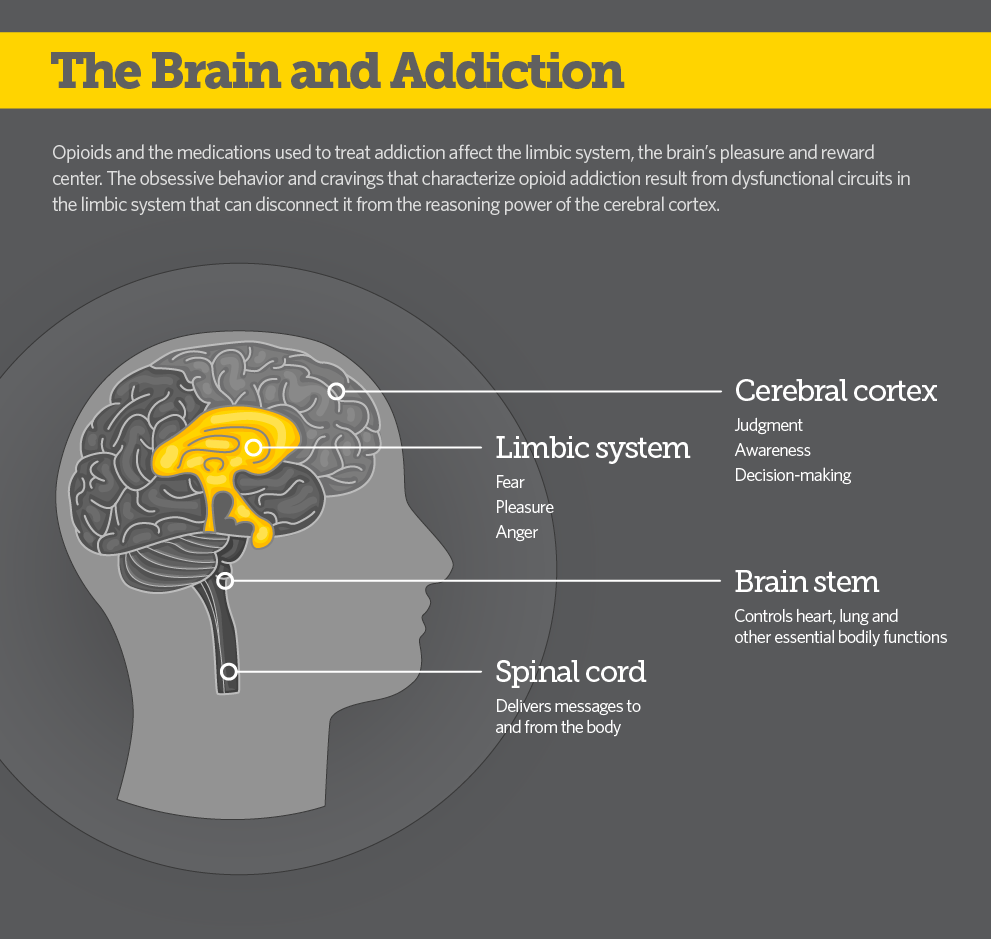
The fact that modern-day conversations about dependency use the word and concept of illness represents a seismic shift in how the medical and public communities comprehend the spectrum of substance abuse. However even as our understanding of human psychology and neuroscience expands, what we believed we knew about addiction (as a disease), and how it works, continues to expose surprises about the science of human habits and idea.